|
Whatsapp Request

Rutas en Croacia (Split - Split)

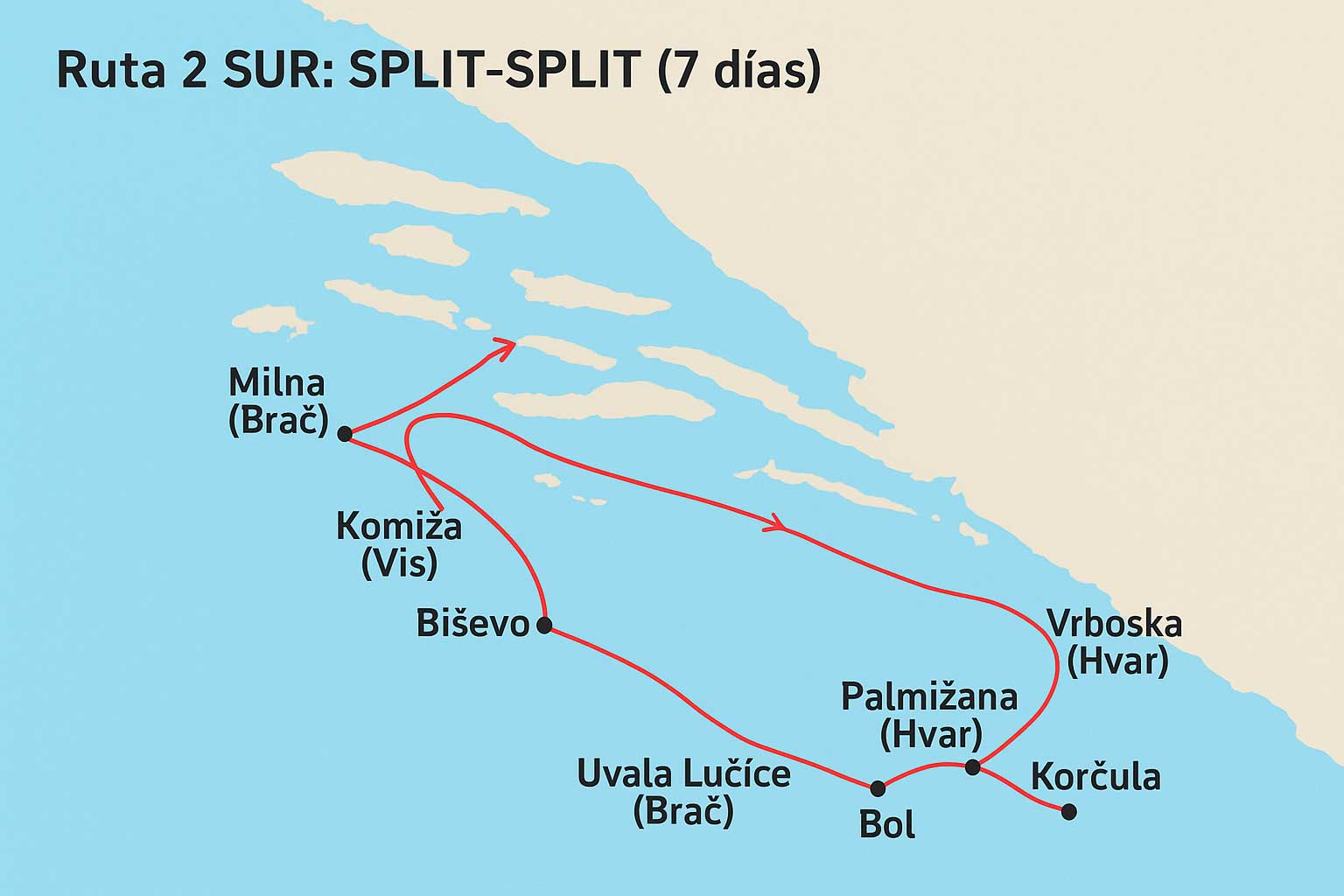
Ruta 2 SUR: SPLIT-SPLIT (7 días)

  • Day 1: Split- Milna (Brac)
  • Day 2: Milna - Komiža (Vis) – Biševo – Vis (Vis)
  • Day 3: Vis - Palmižana (Hvar)
  • Day 4: Palmižana - Korčula (Korčula)
  • Day 5: Korčula - Vrboska (Hvar)
  • Day 6: Vrboska - Bol (Brač) - Uvala Lučice (Brač)
  • Day 7: Uvala Lučice - Bobovišća (Brač) – Split
Mapa de la ruta

Day 1: Split- Milna (Brac)

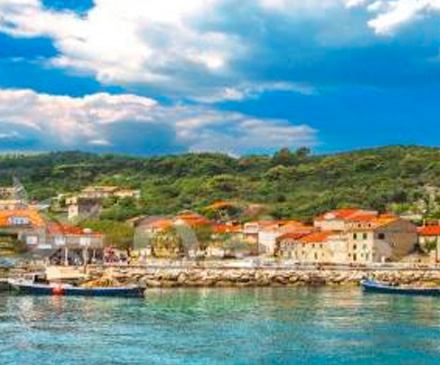
Milna is the most protected and most beautiful harbor on the island of Brač. Sheltered from the strongest winds and refreshed by the summer afternoon mistral, it is the ideal refuge for both people and boats.
Milna is located at the bottom of a wide bay on the western coast of Brač. It often attracts many tourist trips thanks to its crystal-clear blue sea, the shade of centuries-old pine forests, sunlit facades built from Brač stone, ideal conditions for diving, and healthy homemade restaurants – all reasons to visit this beautiful Mediterranean town. Right by the sea, you’ll find excellent seafood restaurants, pizzerias, and bars.

Day 2: Milna - Komiža (Vis) – Biševo – Vis (Vis)

The island of Vis has a unique cultural and historical heritage, crystal-clear sea, beautiful secluded beaches, and many small coves and islets. The entire history of Vis is closely tied to fishing, viticulture, and wine production. The most famous white wine is Vugava from Vis, which can be tasted in many of the island’s restaurants and wineries.
The port and town of Komiža are located on the western coast of the island of Vis, along the northeastern side of the wide Komiža Bay. The harbor is sheltered from eastern and northeastern winds. Komiža is considered the cradle of fishing in the Adriatic, as evidenced by the Fishermen’s Museum in town. It is housed in the old Venetian tower. Wooden shipbuilding over the centuries gave birth to the falkuša, a traditional fishing boat from Komiža, unique in the world for its specific construction and sails.
Not far from the island of Vis, a small paradise island rises from the sea – Biševo. It is famous for its beautiful sandy beaches and colorful underwater life. The coast of Biševo is dotted with many caves, the most famous of which is the Blue Cave, in Balun Bay. On sunny days, at midday, sunlight penetrates the cave through its underwater entrance, reflects off the white rock seabed, and illuminates the cave in stunning shades of blue. Entry to the Blue Cave is only allowed with small rowboats, and only in calm weather without waves.

Day 3: Vis - Palmižana (Hvar)

On the southwestern coast of the island of Hvar lies a group of around 20 islands and reefs, known as the Pakleni Islands, renowned for their natural beauty.

Wild islands in the middle of the crystal-clear blue sea, countless secluded beaches, and stunning solitary coves.

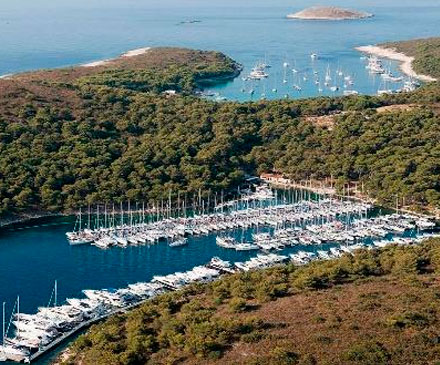
The best shelter in the Pakleni Islands is the ACI Marina Palmižana, located on the northeastern coast of the island of St. Klement, which is protected from all winds. However, with strong southwesterly winds, some waves may occur.

Palmižana is the oldest and most famous resort in Hvar. It is surrounded by dense pine forests and other exotic vegetation.

Day 4: Palmižana - Korčula (Korčula)

The island of Korčula is the jewel of the Adriatic archipelago. The island is surrounded by a number of smaller islands and coves, and by lush vegetation.
Around it, visitors can enjoy swimming on many beaches, as well as diving into an underwater world rich in flora and fauna.
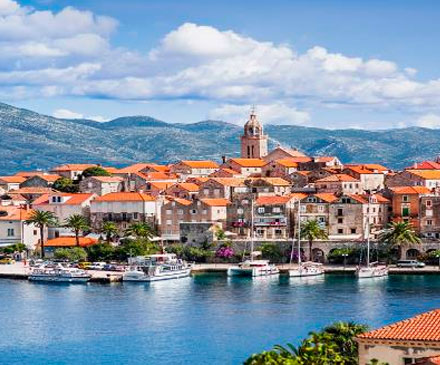
The town of Korčula is the island’s historical and tourist center. It is one of the best-preserved medieval towns in the Mediterranean.
Korčula is also considered the birthplace of the world’s greatest traveler, Marco Polo, whose birth house is located in the heart of the old town.

Day 5: Korčula - Vrboska (Hvar)

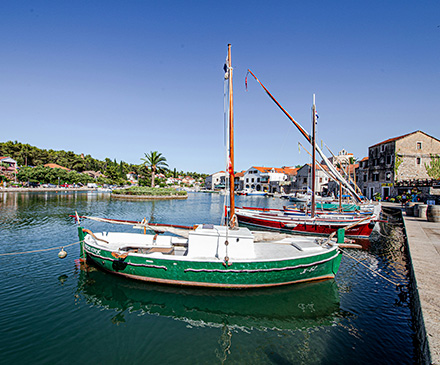
Vrboska is the smallest town on the island of Hvar, located at the end of a deep and narrow bay.
The beautiful islet in the center of the bay, connected by many small bridges, has earned it the nickname “Little Venice.”
Vrboska stands out for its pristine nature, cultural monuments, and the architecture of its winding alleyways.
One of its main attractions is the Fishermen’s Museum, whose permanent exhibition showcases all the traditional fishing equipment.

Day 6: Vrboska - Bol (Brač) - Uvala Lučice (Brač)

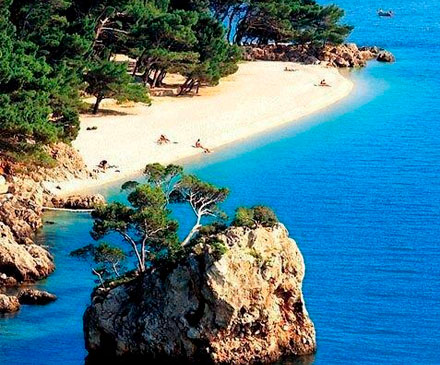
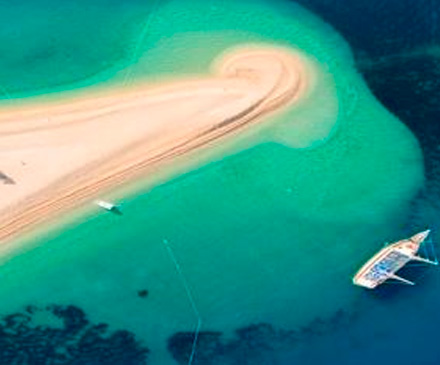
Bol is the oldest town on Brač. It is located in the central part of the island’s southern coast, beneath the Bolska Kruna mountain range and Vidova Gora, the highest peak of the Croatian Adriatic islands. The area is famous for its beautiful beaches, the most renowned being Zlatni Rat. It is considered the most beautiful beach in the Adriatic and a unique natural attraction. This gravel cape is a natural phenomenon that stretches over half a kilometer into the sea, with its shape and angle constantly changing according to the will of the waves and sea currents.
Uvala Lučice is one of the most popular anchorages in the Adriatic. It resembles a three-leaf clover and is distinguished by its crystal-clear waters and lush pine forest.

Day 7: Uvala Lučice - Bobovišća (Brač) – Split

Bobovišća is located on the western side of the island of Brač, within one of the most beautiful bays of the Adriatic. The bay branches at its end into the port of Bobovišća and Vičja Luka. Vičja Luka is one of the most important Croatian sites containing remains of Illyrian and Greek civilizations. The surrounding hills protect Bobovišća from all winds.

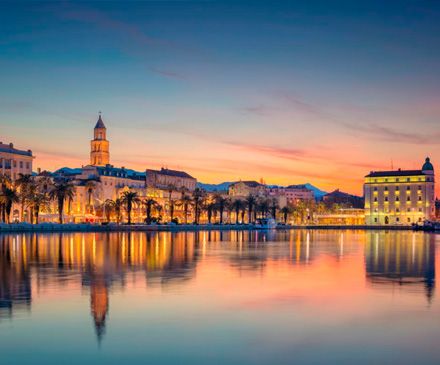
We will spend the last night in Split, and we cannot overlook some facts that give this place its character. It is worth knowing that the old town is closely linked to the Roman Empire. It was founded in the 4th century, when Emperor Diocletian, a native of the region, had his palace built here to live in after retiring from political life. Today, it is one of the best-preserved Roman palaces in the world.

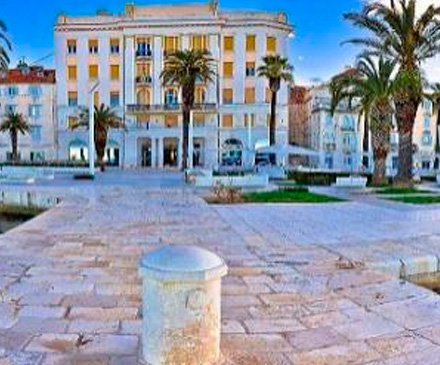
If you feel like taking a walk along the seaside promenade (La Promenade), you will find Renaissance-style monuments such as Republike Square, located very close to the Romanesque church of St. Lawrence and Popolo Square. Without a doubt, this city is the ideal place to get lost, with its streets resembling endless labyrinthine alleyways blending different architectural styles, all enveloped by the salty scent of the sea. One could spend hours strolling through its streets, visiting the churches of St. Nikola and Gospa od Zvonika.


Other routes in Croatia

Croacia Routes (Montenegro)

Croacia Routes (Montenegro)

Itinerarios: 8

Route in Croatia (Dubrovnik - Split)

Route in Croatia (Dubrovnik - Split)

Itinerarios: 7

Rutas en Croacia (Split - Split)

Rutas en Croacia (Split - Split)

Itinerarios: 7

Our commitment

At Bestgulet, we are very familiar with the gulets we offer. We have been onboard, we know the owner, the captain, and we have tried their delicious menus, which sets us apart from most companies offering gulets online. This aspect is crucial when recommending a gulet, as depending on your budget and preferences, we will always suggest the best option and guarantee your choice.

Additionally, we offer you our network of partners in Turkey, Croatia, Italy... who will be happy to assist you once you arrive at the destination.